Baduanjin (Eight Brocades): What It Is, Benefits, and How to Get Started
Published on May 19, 2026 | Updated on May 28, 2026
Table of Contents
- What Is Baduanjin (Eight Brocades)?
- Baduanjin vs Tai Chi vs Qigong
- Baduanjin Benefits
- Baduanjin for Seniors
- Baduanjin for Beginners: The Eight Movements
- Building a Baduanjin Routine
- FAQ
- Begin Your Practice Today
Baduanjin is one of China's most enduring wellness practices — a sequence of eight movements that has been taught, refined, and practised continuously for over a thousand years. Today it is one of the most extensively researched traditional Chinese exercises, with a growing body of clinical trials confirming benefits across balance, cardiovascular health, musculoskeletal function, and mental wellbeing. This guide covers what Baduanjin is, how it fits alongside Tai Chi and Qigong, what the research shows, and how to learn all eight movements from scratch.
What Is Baduanjin (Eight Brocades)?
Baduanjin (八段锦) translates literally as "Eight Pieces of Brocade" or "Eight Section Brocades." The name reflects the traditional view of the practice: eight movements as precious and refined as silk brocade, each designed to benefit a specific aspect of health. The practice is attributed in some traditions to the Song Dynasty general Yue Fei (1103–1142 AD), though historical records suggest it existed in various forms considerably earlier. The earliest written documentation dates to the Song Dynasty (960–1279 AD).
Baduanjin exists in two main versions: a standing form (Li Shi Ba Duan Jin) and a seated form (Zuo Shi Ba Duan Jin). The standing form is by far the more widely practised and is the subject of the clinical research cited in this article. A standardised modern form was developed by the Chinese Health Qigong Association in 2003, making it one of five officially endorsed Health Qigong forms practised worldwide today.
A complete Baduanjin session — performing each of the eight movements six to eight times — takes approximately 15 to 20 minutes, making it one of the most time-efficient complete-body wellness practices available.
Baduanjin vs Tai Chi vs Qigong
These three practices are closely related and frequently confused. The distinctions are worth understanding clearly.
| Baduanjin | Tai Chi | Qigong | |
|---|---|---|---|
| Type | Fixed 8-movement sequence | Long flowing form (24–108 moves) | Broad category of practices |
| Learning curve | Moderate — fixed sequence to learn | Higher — longer and more complex forms | Variable — individual exercises are simplest |
| Session length | 15–20 min for a complete set | 20–40 min for a full form | 5–30 min depending on practice |
| Movement style | Symmetrical, standing, structured | Continuous flowing transitions | Still, gentle swaying, or flowing |
| Primary focus | Full-body health and organ function | Balance, coordination, martial principles | Breath, energy, internal awareness |
| Best for | Complete beginners wanting a structured programme | Those who enjoy sequence learning | Those prioritising breath and meditation |
For beginners choosing between the three, Baduanjin occupies a useful middle ground: more structured than free-form Qigong exercises, but shorter and simpler than a full Tai Chi form.
Baduanjin Benefits
Baduanjin is among the most researched traditional Chinese exercises in the clinical literature. The following benefits are supported by peer-reviewed systematic reviews and meta-analyses.
Baduanjin for Seniors
Baduanjin is one of the most appropriate forms of exercise for older adults across a wide range of fitness levels. Its standing postures are gentle and fully weight-bearing without being high-impact; its repetitive, symmetrical movements build lower-body strength progressively; and its emphasis on coordinated breathing supports both cardiovascular and respiratory health.
The Jones et al. 2022 meta-analysis, which focused specifically on adults aged 65 and above, confirmed meaningful benefits across multiple functional domains including balance, physical function, and anxiety reduction. The practice is well-suited to seniors managing arthritis, hypertension, early bone loss, or reduced cardiovascular capacity — all conditions for which the research cited above shows a relevant benefit.
For seniors beginning Baduanjin, the following adaptations support safe practice:
- Reduce stance depth initially. Several movements involve a semi-squat position. Beginning with a shallower stance reduces load on the knees and hips until strength and confidence build.
- Use a chair or wall for support during movements that challenge single-leg balance in the early weeks of practice.
- Omit Movement 6 if forward bending is contraindicated. The forward bend in Movement 6 (Two Hands Hold the Feet) can be replaced with hands on the shins or knees for those with lumbar sensitivity.
- Consult a healthcare provider before beginning if you are managing severe osteoporosis, recent joint replacement, or uncontrolled cardiovascular conditions.
Baduanjin for Beginners: The Eight Movements
Each movement in Baduanjin has a traditional name describing its appearance or its associated benefit within TCM theory. The organ associations are drawn from Traditional Chinese Medicine and represent a traditional wellness framework rather than claims of proven physiological effect in Western medical terms.
Perform each movement six to eight times before proceeding to the next. Move slowly, breathe diaphragmatically throughout, and coordinate the breath with the movement — generally inhaling on opening or expanding phases and exhaling on closing or lowering phases.
1. Two Hands Hold Up the Heavens (两手托天理三焦)
Traditional association: Triple Heater / whole-body regulation
Interlace the fingers in front of the lower abdomen, palms facing up. As you inhale, slowly raise the hands upward along the body's centre line, rotating the palms to face the ceiling as they pass chest height, and extend the arms fully overhead. Gently rise onto the toes if comfortable. As you exhale, separate the hands and lower the arms outward and down to the sides. This movement stretches the entire spine and ribcage, opens the chest, and trains coordinated whole-body extension.
2. Drawing the Bow to Shoot the Eagle (左右开弓似射雕)
Traditional association: Lungs and large intestine
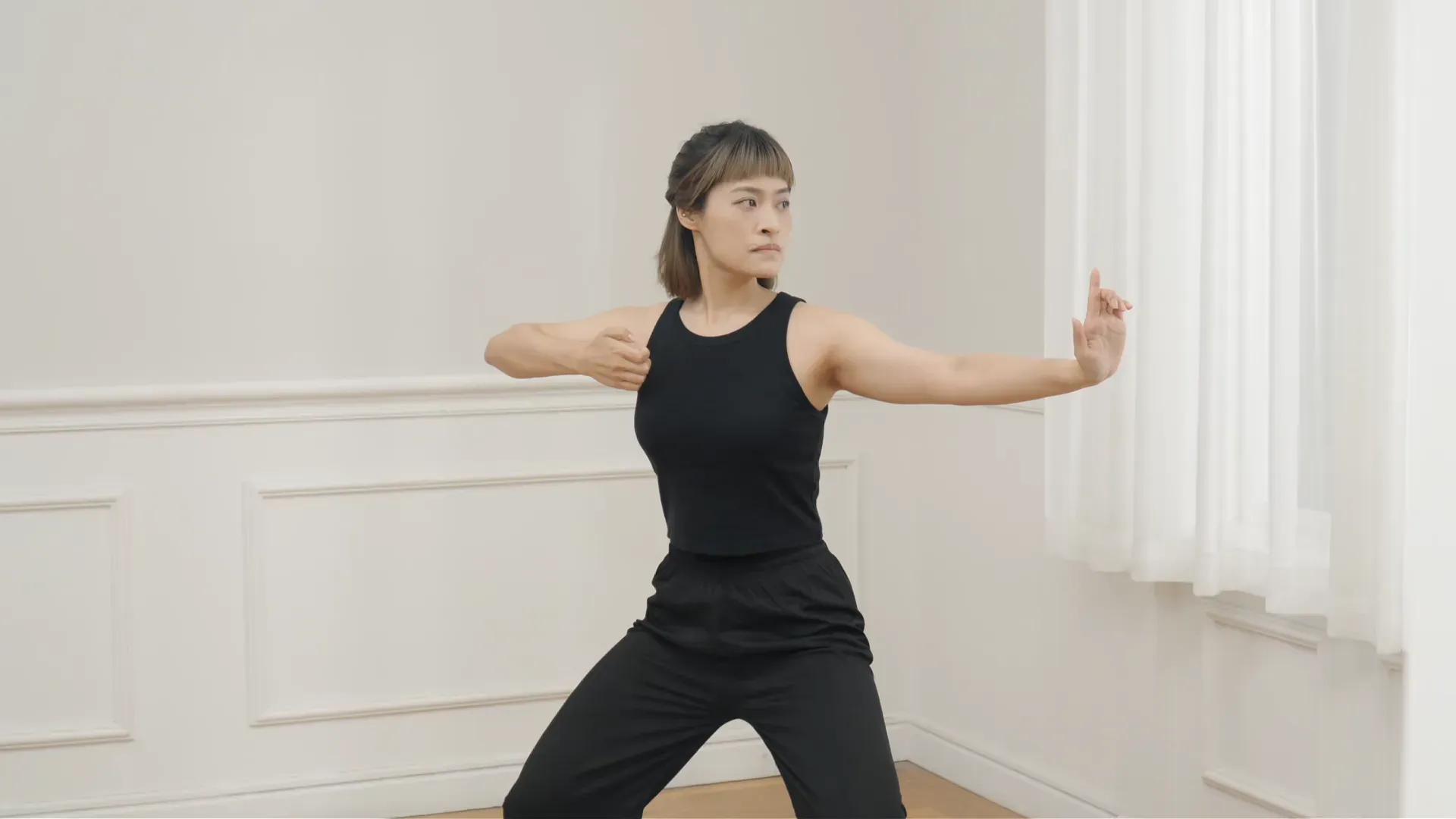
Step or stand wide (wider than shoulder-width), with knees bent in a low horse stance. Extend the right arm forward as if holding a bow, index finger and thumb open. Draw the left elbow back at shoulder height as if pulling the bowstring. Hold for a breath, then switch sides. This movement strengthens the arms, chest, and upper back, and opens the thoracic cavity to support deeper breathing.
3. Separating Heaven and Earth (调理脾胃须单举)
Traditional association: Spleen and stomach
From a shoulder-width stance, press the right hand upward — palm facing the ceiling — while pressing the left hand downward — palm facing the floor. Hold for a breath, then switch. The opposing stretch through the trunk stimulates the abdominal organs and lengthens the lateral muscles of the spine.
4. Wise Owl Gazes Backward (五劳七伤往后瞧)
Traditional association: Neck, spine, and nervous system
Stand with arms relaxed at the sides, feet shoulder-width apart. Slowly turn the head to look over the right shoulder, rotating as far as is comfortable without tension. Hold for a breath, then rotate to the left. The rest of the body remains still. This movement trains cervical mobility and spinal rotation, and is particularly beneficial for those who spend long hours at a desk.
5. Sway the Head and Shake the Tail (摇头摆尾去心火)
Traditional association: Heart
Stand in a wide horse stance, hands resting on the thighs. Lean the torso forward slightly and slowly sway — tilting the head to the right while the tailbone shifts to the left in a gentle arc, then reversing. Move continuously and smoothly, like a pendulum. This movement releases tension in the cervical and lumbar spine and trains lateral mobility.
6. Two Hands Hold the Feet (两手攀足固肾腰)
Traditional association: Kidneys and lower back
Stand with feet shoulder-width apart. Place both hands on the lower back, pause, then slowly slide the hands down the back of the legs as you fold forward — reaching toward the feet or as far as comfortable. Pause at the lowest point, then place the hands on the lower back and slowly rise. This movement strengthens and stretches the entire posterior chain, from the Achilles tendons to the lumbar spine.
7. Clench the Fists and Glare Fiercely (攒拳怒目增气力)
Traditional association: Liver and muscular system
Stand in a wide horse stance with fists held at the hips, palms facing up. Slowly punch one fist forward, rotating it palm-down as it extends, while the eyes open wide and focus intently ahead. Draw the fist back and repeat on the other side. The physical intensity of this movement is unique within the sequence — it builds upper-body strength and trains the focused, intentional quality that Baduanjin shares with its martial arts roots.
8. Bouncing on the Heels (背后七颠百病消)
Traditional association: Whole body / spine alignment
Stand with feet together, arms relaxed at the sides. Slowly rise onto the toes, pause briefly, then gently lower the heels back to the floor with a soft bounce — not a hard impact. Repeat seven times. This closing movement is said in tradition to consolidate the benefits of the preceding seven. Mechanically, it trains ankle stability, gently compresses and realigns the vertebrae, and stimulates circulation through the feet and legs.
Building a Baduanjin Routine
| Week | Movements practised |
|---|---|
| Week 1 | Movements 1 and 2 |
| Week 2 | Movements 1–4 |
| Week 3 | Movements 1–6 |
| Week 4 | Full sequence (all 8) |
FAQ
The basic form of all eight movements can be learned over four to six weeks of consistent daily practice. Developing fluency — performing the sequence smoothly with coordinated breathing and correct alignment — typically takes two to three months. Like all traditional practices, Baduanjin continues to deepen with years of consistent engagement.
Yes. Baduanjin requires no baseline fitness, flexibility, or prior movement experience. Its movements are performed at a self-selected pace, can be modified for limited range of motion, and place no high-impact demands on the joints. It is one of the most genuinely accessible structured exercise practices for adults beginning movement from scratch.
Daily practice is traditional and consistent with the research evidence, which observes the strongest results from consistent engagement over 12 to 24 weeks. If daily practice is not possible, a minimum of three to four sessions per week is sufficient to build the movement patterns and cumulative benefit that make the practice effective.
Yes. A seated version of Baduanjin (Zuo Shi Ba Duan Jin) adapts the movements for chair practice, making it accessible to those who cannot stand for extended periods. The seated form modifies Movements 5, 6, and 8 most significantly but preserves the essential qualities of breath coordination and upper-body movement across all eight exercises.
No. While both practices share roots in Traditional Chinese Medicine and Qigong principles, they are distinct. Baduanjin is a fixed eight-movement sequence focused on whole-body health; Tai Chi is a longer, flowing martial-arts-derived form focused on balance, coordination, and postural alignment. Many practitioners engage in both as complementary practices.
Begin Your Practice Today
Baduanjin offers one of the most complete and accessible entry points into traditional Chinese wellness practice — a fixed, learnable sequence with over a thousand years of refinement and a growing clinical evidence base behind it. Fifteen to twenty minutes a day is sufficient to experience its benefits across physical strength, balance, cardiovascular health, and mental wellbeing.