Qigong for Beginners: What It Is, 5 Exercises to Start With, and How to Build a Daily Routine
Published on May 18, 2026 | Updated on June 15, 2026
Table of Contents
- What Is Qigong and How Is It Different from Tai Chi?
- Qigong Benefits for Beginners
- Beginner Qigong Exercises: 5 Movements to Start With
- How to Build a Beginner Qigong Routine
- Begin Your Qigong Practice Today
- FAQ
Qigong is one of the most accessible entry points into Chinese wellness practice — and one of the most misunderstood. Many people assume it requires significant flexibility, prior meditation experience, or knowledge of Traditional Chinese Medicine. It requires none of these. If you can breathe slowly and stand still, you can begin today. This guide explains what Qigong is, how it differs from Tai Chi, what the research shows about its benefits, and five foundational exercises that are appropriate for complete beginners.
What Is Qigong and How Is It Different from Tai Chi?
Tai Chi is, in many ways, a specialised form of Qigong — one that applies Qigong principles within a structured sequence of martial-arts-derived movements. The key practical differences for beginners are:
| Qigong | Tai Chi | |
|---|---|---|
| Structure | Individual exercises or short sequences | Fixed forms with specific sequences to memorise |
| Learning curve | Lower — most exercises can be learned in one session | Higher — full forms take weeks to months |
| Movement style | Can be still, gentle swaying, or flowing | Continuous flowing movement |
| Focus | Breath, energy, internal awareness | Breath, movement coordination, postural alignment |
| Best for beginners? | Yes — simpler entry point | Yes — but requires more initial guidance |
Qigong Benefits for Beginners
The health benefits of Qigong are supported by a growing body of peer-reviewed research across multiple areas of physical and mental health.
Beginner Qigong Exercises: 5 Movements to Start With
These five exercises form a complete introductory foundation for Qigong practice. Each teaches a core principle — breathing, stillness, energy movement, release, or closing — that applies across all more advanced Qigong practices. They can be practised individually or sequentially as a single routine.
1. Natural Abdominal Breathing
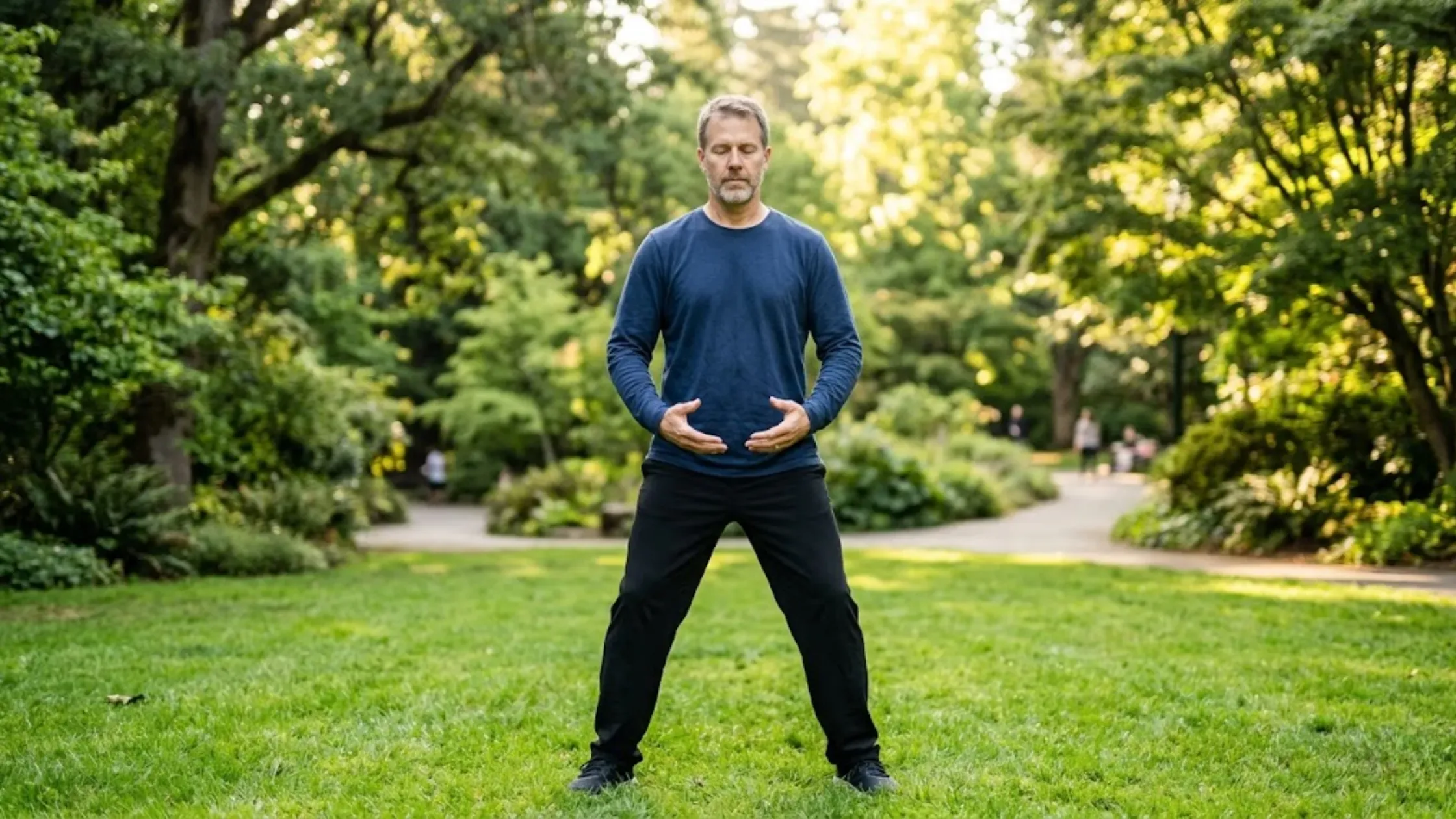
Stand with feet shoulder-width apart, knees slightly soft, arms relaxed at the sides. Place one hand lightly on the lower abdomen, just below the navel. Inhale slowly through the nose for four counts, allowing the belly to expand outward against your hand — not the chest. Exhale through the nose for six counts, feeling the belly draw gently back. Keep the shoulders completely relaxed; they should not rise on the inhale.
Practise for three to five minutes. This is the foundational skill of all Qigong practice. The ability to breathe fully and abdominally — rather than shallowly into the chest — is what distinguishes Qigong breathing from habitual breathing patterns and is the basis for every exercise that follows.
2. Zhan Zhuang — Standing Like a Tree
From the same standing position, raise both arms to chest height, rounded, as if embracing a large tree trunk. Palms face inward. Knees remain softly bent. The crown of the head lifts gently. Close or soften the eyes. Hold this position for two to five minutes, breathing slowly and abdominally throughout.
Zhan Zhuang (standing meditation) is one of the most fundamental Qigong practices across all traditions. Despite its apparent simplicity, it develops deep postural awareness, lower-body strength, and the quality of sustained, relaxed attention that all Qigong movement depends upon. Most beginners find two minutes challenging at first; that difficulty itself indicates productive training.
3. Two Hands Hold Up the Heavens
This is the first of the Eight Pieces of Brocade (Ba Duan Jin) — one of the oldest and most widely practised Qigong sequences. From a shoulder-width stance, interlace the fingers in front of the lower abdomen, palms facing up. As you inhale, slowly raise the interlaced hands upward, turning the palms to face the ceiling as they pass chest height, and extend the arms fully overhead. Rise gently onto the toes if comfortable. As you exhale, separate the hands, lower the arms slowly outward and down to the sides, and return to the starting position. Repeat six to eight times.
This exercise stretches the spine, ribcage, and shoulder girdle, stimulates the digestive organs through gentle traction, and coordinates the full breath cycle with whole-body movement — a core principle of Qigong practice.
4. Swinging Arms (Shuai Shou)
Stand with feet slightly wider than shoulder width, arms relaxed at the sides. Allow both arms to swing naturally forward and back — like a pendulum — by gently rotating the torso left and right. Let the arms be completely passive, driven only by the torso rotation. The back of each hand gently taps the opposite hip or lower back as it swings through. Begin slowly and allow the swing to find its own rhythm. Continue for one to two minutes.
This is one of the simplest and most physically releasing Qigong exercises. The passive arm movement reduces habitual upper-body tension, and the gentle spinal rotation stimulates circulation along the kidney meridian — an important area in Traditional Chinese Medicine associated with energy and vitality.
5. Three Returns to Dan Tian (Closing Exercise)
From a relaxed standing position, bring both hands in front of the lower abdomen, palms facing up, one hand resting over the other. As you inhale, raise the hands slowly up the centre line of the body to chest height. As you exhale, gently press the hands back down to the lower abdomen. Repeat three times. This closing movement signals the end of practice and is used in most Qigong traditions to settle the energy cultivated during the session.
Tip: See our video guide on YouTube: Fix Neck & Shoulder Tension, Stiff Joints Relief.
How to Build a Beginner Qigong Routine
Begin Your Qigong Practice Today
Qigong asks very little to begin: a clear space, ten minutes, and the willingness to breathe slowly. The five exercises in this guide are enough to build a genuine foundation — and the benefits are accessible from the very first session.
FAQ
Yes. Qigong has no baseline fitness requirement. It can be adapted for standing, seated, or even lying-down practice, and the exercises described above require only the ability to stand comfortably and breathe. It is one of the few genuine forms of exercise that is equally accessible to a 30-year-old office worker and a 75-year-old with limited mobility.
Many practitioners report a noticeable reduction in tension and mental calm after the very first session — particularly from abdominal breathing and Zhan Zhuang practice. More sustained benefits, such as improved sleep quality, reduced anxiety, and better morning energy, are typically observed after two to four weeks of consistent daily practice.
A qualified teacher provides the most direct feedback on posture and breathing mechanics. For those who cannot access in-person instruction, structured video programmes led by certified instructors offer a practical alternative. Unguided practice from text descriptions alone is possible for the most basic exercises but carries a higher risk of developing incorrect breathing habits that limit long-term progress.
Meditation typically involves stillness — sitting or lying quietly with the focus on the breath or an object of attention. Qigong combines mental focus with gentle physical movement, making it more accessible for people who find sitting meditation difficult. The two practices are complementary: Qigong tends to be an easier entry point, while meditation develops deeper sustained attention over time.
Qigong is generally very low-risk and has been studied in clinical populations including cancer patients, people with cardiovascular disease, and older adults with chronic conditions. However, if you have a serious medical condition, recent surgery, or have been advised to limit physical activity, consult your healthcare provider before beginning a new practice.