Chair Tai Chi: Seated Exercises, Workout Plan and Benefits
Published on May 16, 2026 | Updated on June 17, 2026
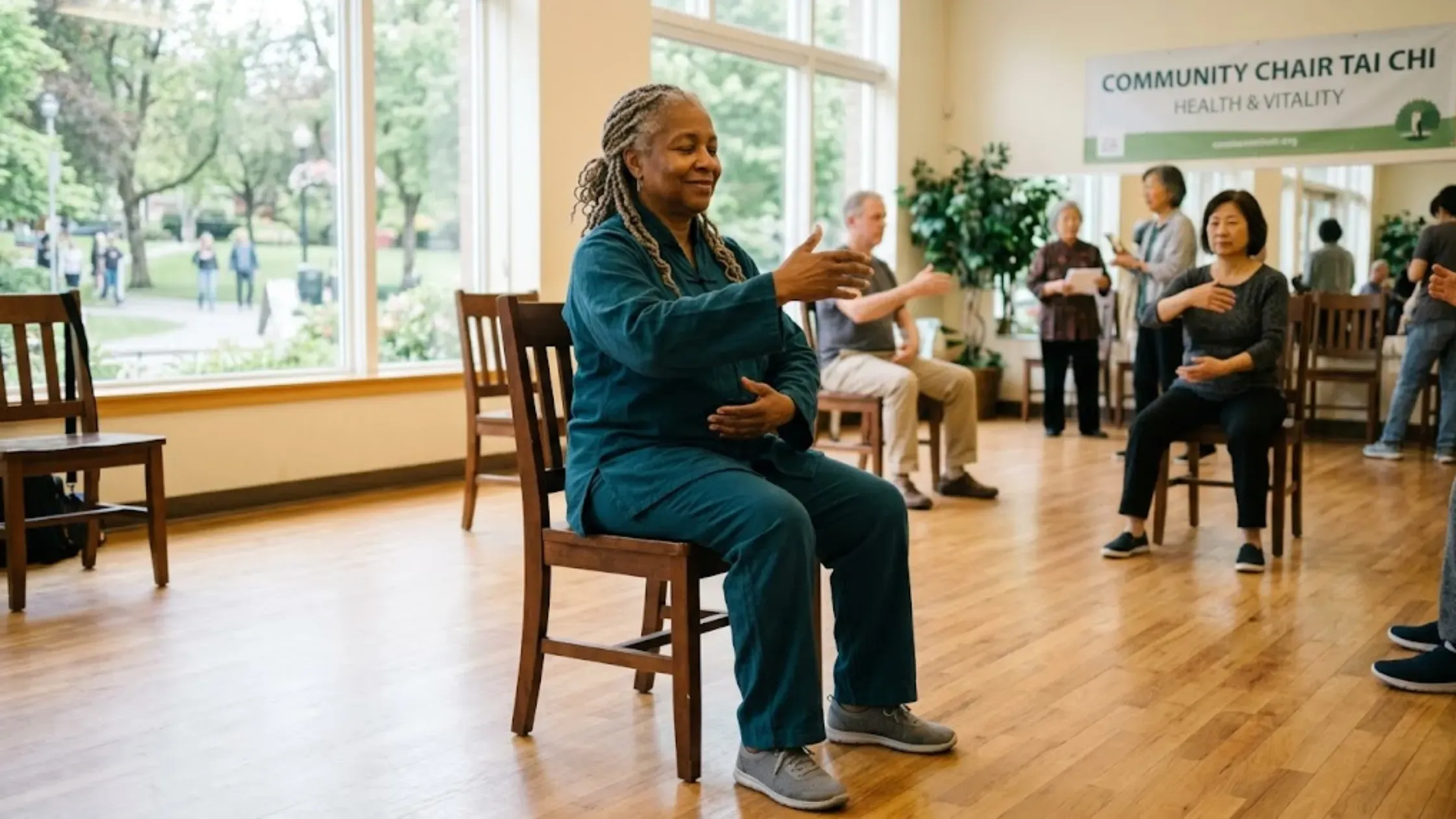
Table of Contents
- What Is Chair Tai Chi?
- Does Chair Tai Chi Work? What the Research Shows
- Chair Tai Chi Benefits for Seniors and Beginners
- Chair Tai Chi Exercises: 6 Movements to Start With
- Chair Tai Chi Workout Plan: 4 Weeks for Beginners
- Tips for Practising Seated Tai Chi at Home
- Begin Your Chair Tai Chi Practice Today
- FAQ
Chair Tai Chi — also called seated Tai Chi — adapts the slow, mindful movements and coordinated breathing of traditional Tai Chi into a fully or partially seated format. For older adults, people with limited mobility, those recovering from illness or surgery, or anyone for whom prolonged standing is not currently possible, it provides access to the core benefits of Tai Chi practice without requiring standing balance. This guide covers what chair Tai Chi is, what the research shows, six foundational exercises to begin with, and a structured four-week plan to build a consistent practice.
Note: If you have a recent cardiac event, uncontrolled hypertension, advanced cognitive impairment, or recent fracture, consult your healthcare provider before beginning a new exercise programme.
What Is Chair Tai Chi?
Chair Tai Chi is a modified form of traditional Tai Chi performed while seated in a sturdy, armless chair. It adapts the foundational principles of Tai Chi — slow, coordinated movement, diaphragmatic breathing, and sustained mindful attention — into postures and sequences that do not require standing balance or lower-body mobility.
The movements draw primarily from Yang-style and Sun-style Tai Chi, both of which are characterised by upright posture, flowing arm movements, and a moderate, consistent pace. In the seated format, the focus shifts toward the upper body, breath, and core stability, while the lower body participates in weight shifting and grounding rather than stepping.
Chair Tai Chi is recommended by several major health organisations for older adults and those with mobility limitations, including the Arthritis Foundation and the National Council on Aging (NCOA), as a safe and accessible form of low-impact exercise.
Does Chair Tai Chi Work? What the Research Shows
This is one of the most common questions from people new to the practice — and the evidence supports a clear answer: yes, with appropriate expectations.
Chair Tai Chi Benefits for Seniors and Beginners
Chair Tai Chi Exercises: 6 Movements to Start With
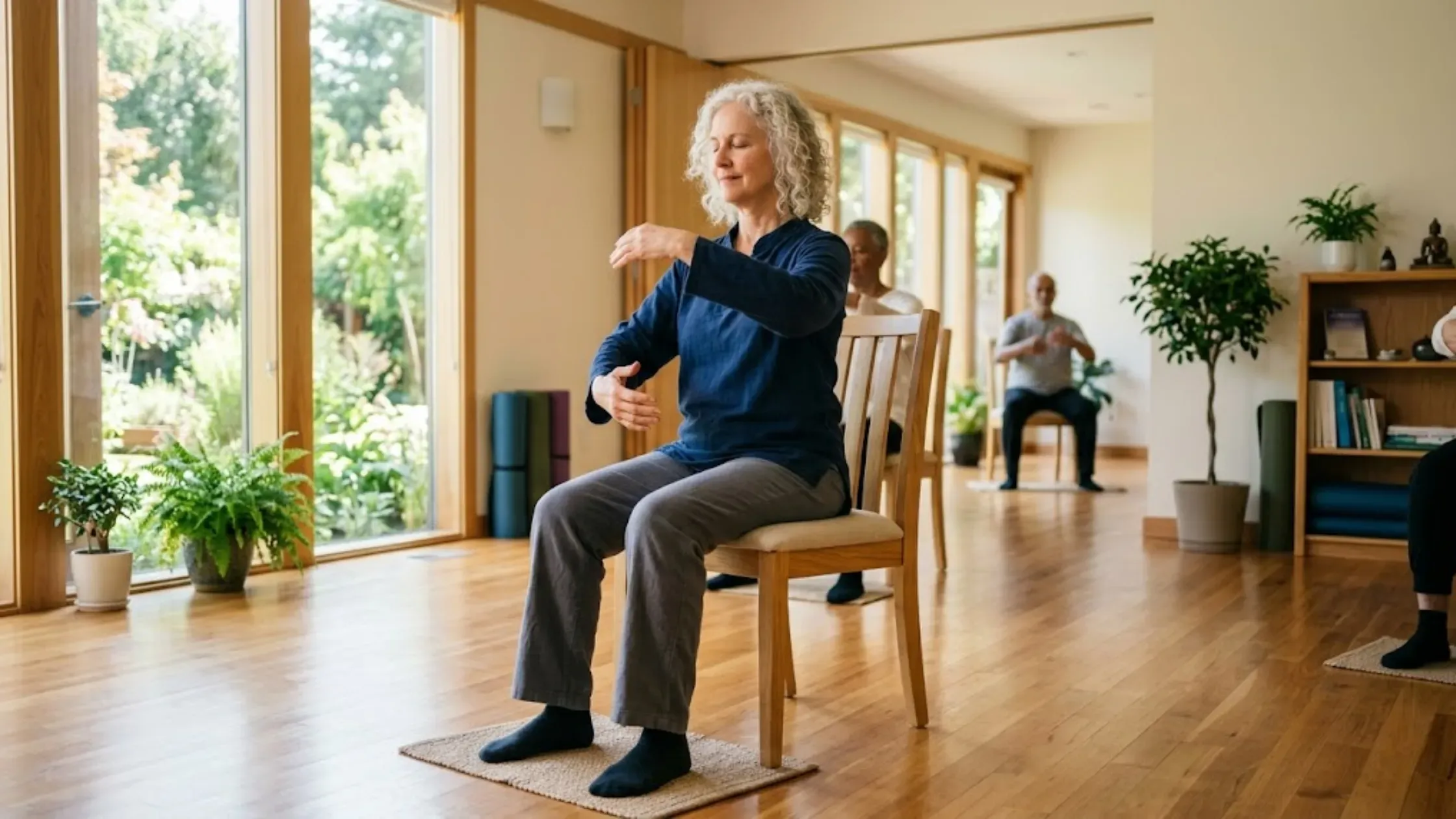
These six movements form the foundation of most chair Tai Chi programmes. Each can be practised individually or combined into a flowing sequence. Sit in a sturdy, armless chair with both feet flat on the floor and your spine upright — not resting against the chair back.
1. Seated Centring Breath
Sit upright with hands resting on your thighs. Inhale slowly through the nose for four counts, allowing the belly to expand outward. Exhale through the nose or mouth for six counts, allowing the belly to draw gently inward. Repeat five to eight times. This is the opening movement of every session — it establishes the breathing rhythm that all subsequent movements should follow.
2. Raising and Lowering the Arms
From the centring position, slowly raise both arms forward to shoulder height, palms facing down, as you inhale. Then slowly lower them back to your thighs as you exhale. The movement should feel weightless — as though the arms float up and settle down without muscular effort. Repeat six to eight times. This is directly adapted from the opening movement of the Yang-style 24-form.
3. Cloud Hands (Seated)
Hold both hands in front of the chest, rounded, as if holding a large soft ball. Slowly rotate the ball to the right — right hand rising to shoulder height, left hand lowering to hip height — then reverse, bringing the left hand up and the right hand down. The torso rotates gently with each transition. Move slowly and continuously, allowing the breath to coordinate with the rotation. Repeat eight to ten times in each direction.
4. Shoulder and Neck Release
Slowly roll both shoulders backward in large circles — up, back, down, and forward — coordinating with the breath. Inhale on the upward phase, exhale on the downward phase. Perform five circles, then reverse direction. Follow with a slow neck turn: look gently to the right as you exhale, return to centre as you inhale, look to the left as you exhale. Keep the movement within a comfortable, pain-free range at all times.
5. Seated Ward Off
Bring the right arm forward to chest height, palm facing inward, as if gently deflecting a slow push. The left hand rests, palm up, at waist level. Hold this position for two breath cycles, feeling the gentle engagement in the shoulder and core. Slowly switch sides. This posture builds shoulder stability and introduces the asymmetrical arm positions characteristic of Tai Chi forms.
6. Seated Forward Open
With both hands at waist height, palms facing up, slowly open the arms outward to the sides as you inhale — as if gently parting a curtain. Then bring them back together at the centre as you exhale. Keep the shoulders relaxed and the elbows soft throughout. Repeat eight times. This movement expands the chest, supports deeper breathing, and introduces the opening and gathering rhythm that runs through many Tai Chi sequences.
Chair Tai Chi Workout Plan: 4 Weeks for Beginners
This plan is designed to build from very short introductory sessions toward a consistent 20-minute daily practice. Session lengths are intentionally conservative in the early weeks — consistency matters more than duration at the start.
| Week | Sessions per week | Session length | Focus |
|---|---|---|---|
| Week 1 | 4–5 | 8–10 min | Centring breath + Raising and Lowering the Arms + Shoulder and Neck Release only. Prioritise posture and breath coordination. |
| Week 2 | 5 | 12–15 min | Add Cloud Hands and Seated Forward Open. Begin linking movements without stopping. |
| Week 3 | 5–6 | 15–18 min | Add Seated Ward Off. Begin practising the full six-movement sequence as a continuous flow. |
| Week 4 | 6–7 | 18–20 min | Full sequence repeated two to three times per session. Begin adding a second daily session (morning + evening) if comfortable. |
Tips for Practising Seated Tai Chi at Home
Begin Your Chair Tai Chi Practice Today
Chair Tai Chi makes the benefits of Tai Chi accessible regardless of current mobility, balance, or fitness level. A consistent daily practice of 10 to 20 minutes — beginning with the six movements outlined above — is enough to build meaningful improvement in joint mobility, breathing, core stability, and mental calm over four to six weeks.
FAQ
Yes. The upper body, breathing, and cognitive engagement components of chair Tai Chi deliver meaningful benefits independently of standing or lower-body movement. Wheelchair users and those with significant lower-body limitations can still develop improved joint mobility, breathing capacity, postural stability, and mental wellbeing through consistent seated practice.
Eight to ten minutes is an appropriate starting point for beginners. Most practitioners progress toward 20-minute sessions over four to six weeks. For sleep and stress benefits specifically, a short session of 10 to 15 minutes in the evening is effective even without longer daytime practice.
Chair Tai Chi's slow, non-impact movements are generally well-tolerated by people with arthritis. The gentle joint mobilization of repeated circular arm movements supports synovial fluid circulation and range of motion maintenance. The Arthritis Foundation includes chair Tai Chi among its recommended low-impact exercise options for people with arthritis. Those with severe or acutely inflamed joints should consult their healthcare provider before beginning.
They share a seated format and an emphasis on breath and mindful movement, but they draw from different traditions and use different movement vocabularies. Chair yoga adapts yoga postures — stretches, holds, and breathing exercises — while chair Tai Chi adapts the flowing, continuous movement sequences of Chinese Tai Chi forms. Many people find both practices complementary and practice both.
Only a suitable chair. No mats, weights, resistance bands, or other equipment are required.