Tai Chi Walking: A Complete Guide for Beginners, Seniors, and Weight Loss
Published on May 9, 2026 | Updated on May 27, 2026
Table of Contents
- What Is Tai Chi Walking?
- Tai Chi Walking vs Regular Walking
- Tai Chi Walking for Seniors
- Tai Chi Walking for Balance
- Tai Chi Walking for Weight Loss
- Tai Chi Walking for Beginners: Step by Step
- Indoor Tai Chi Walking
- FAQ
- Start Practicing Today
What Is Tai Chi Walking?
Tai Chi walking is a foundational movement practice rooted in traditional Tai Chi Chuan, a Chinese internal martial art developed several centuries ago. Unlike ordinary walking, which relies on momentum and speed, Tai Chi walking is slow, deliberate, and deeply mindful. Each step involves a conscious weight shift, precise foot placement, upright posture, and coordinated breathing — making it far more than a simple stroll.
At its core, Tai Chi walking trains three essential principles: complete weight transfer from one leg to the other, structural alignment of the spine and joints, and present-moment body awareness. These principles make it a powerful entry point into broader Tai Chi and Qigong practice.
Practiced consistently, Tai Chi walking can improve balance, coordination, joint mobility, and leg strength. It also encourages better circulation, calmer breathing, and more efficient movement patterns — benefits that carry over directly into everyday life.
Tai Chi Walking vs Regular Walking
At first glance, Tai Chi walking and regular walking appear to be the same activity — both involve stepping forward, one foot at a time. The difference lies entirely in how each movement is executed and what it trains.
Regular walking is momentum-driven. The body leans slightly forward, the legs cycle automatically, and the mind is typically elsewhere. Speed and distance are the measurable outcomes. Tai Chi walking, by contrast, is deliberate and internally focused. Each step begins with a complete weight shift onto a single leg. The other foot moves only once it is fully "empty." The heel makes contact first, the foot rolls flat, and weight transfers gradually and consciously. At no point does speed or stride length take priority over control.
This distinction has practical consequences. Regular walking builds cardiovascular endurance and burns calories efficiently. Tai Chi walking builds neuromuscular control, postural alignment, and balance — qualities that support safe, functional movement throughout daily life. Research comparing the two has found that Tai Chi produces similar improvements to walking in aerobic capacity and body composition, while demonstrating greater impact on resting metabolic rate and self-perceived mental health. For individuals who find high-impact or fast-paced exercise difficult, Tai Chi walking offers a genuinely effective alternative rather than a compromise.
Tai Chi Walking for Seniors
Tai Chi walking is particularly well-suited for older adults. Its low-impact nature places minimal stress on the joints while delivering meaningful physical and neurological benefits.
Beyond musculoskeletal health, research published in BMC Geriatrics suggests that Tai Chi and Qigong practice can enhance postural stability and cognitive function in older individuals — both of which directly reduce fall risk.
For seniors, the key advantages of Tai Chi walking include:
- Fall prevention: Controlled weight shifting builds single-leg stability, which is one of the most critical factors in preventing falls.
- Joint-friendly movement: Heel-to-toe stepping with gradual weight transfer reduces impact load on the knees and hips.
- Improved confidence: As balance improves, seniors often report greater ease and confidence in daily mobility tasks such as climbing stairs or walking on uneven surfaces.
- Cognitive engagement: The mindful, patterned nature of Tai Chi walking activates focused attention, which supports brain health alongside physical conditioning.
Seniors new to Tai Chi walking should begin with 5 to 10 minutes per session and gradually increase duration as strength and balance improve. Those with existing medical conditions should consult a healthcare provider before starting any new exercise program.
Tai Chi Walking for Balance
Balance is not a fixed physical trait — it is a trainable skill, and Tai Chi walking is one of the most targeted ways to develop it. Unlike most exercise forms that train balance incidentally, Tai Chi walking places controlled weight transfer at the centre of every movement, making it a deliberate practice in single-leg stability and postural control.
The mechanism is straightforward. Each step requires the practitioner to stand fully on one leg while the other foot moves through space. The slow pace eliminates the momentum that ordinarily masks poor balance in everyday walking. Without momentum to rely on, the muscles of the ankle, knee, hip, and core must actively stabilise the body — building strength and proprioceptive awareness with every repetition.
Research supports this effect across multiple populations. The 2021 meta-analysis cited in the Seniors section found significant improvements in postural control as well as walking function — two distinct but related markers of balance competency. A 12-week study combining Tai Chi and brisk walking found measurable improvements in balance, flexibility, and muscular strength in older women, reinforcing Tai Chi's role as a dedicated balance intervention.
For those recovering from injury, managing a neurological condition, or simply noticing that balance has declined with age, Tai Chi walking provides a low-risk, evidence-supported training method. Progress tends to be gradual but cumulative — practitioners typically notice improvements in everyday tasks, such as navigating stairs, stepping off curbs, or standing on one leg to dress, within several weeks of consistent practice.
Tai Chi Walking for Weight Loss
Tai Chi walking is not a high-intensity calorie-burning workout, and it should not be positioned as a replacement for more vigorous exercise in weight management programs. However, the scientific evidence suggests it contributes meaningfully to metabolic health when practiced consistently.
A study comparing Tai Chi and conventional walking training found that both produced similar positive effects on aerobic capacity and body composition. Notably, Tai Chi demonstrated a higher impact on resting oxygen consumption and resting energy expenditure compared to walking alone — meaning the body continues to benefit metabolically even at rest after a Tai Chi session.
A cluster randomized controlled trial also found that Tai Chi exercise produced favorable effects on metabolic syndrome parameters, supporting its role in a holistic weight management strategy.
The weight-related benefits of Tai Chi walking are best understood through three mechanisms:
- Increased daily movement: Tai Chi walking provides structured, regular physical activity that helps offset a sedentary lifestyle.
- Muscle engagement: Slow, controlled stepping activates the quadriceps, hamstrings, glutes, and core — muscles that support metabolic rate.
- Stress reduction: Chronic stress elevates cortisol, which promotes fat storage. Tai Chi's meditative quality has been shown to reduce perceived stress and anxiety, indirectly supporting healthier body composition over time.
For those pursuing weight loss, Tai Chi walking works best as part of a consistent routine that also includes balanced nutrition and, where appropriate, more aerobic activity.
Tai Chi Walking for Beginners: Step by Step
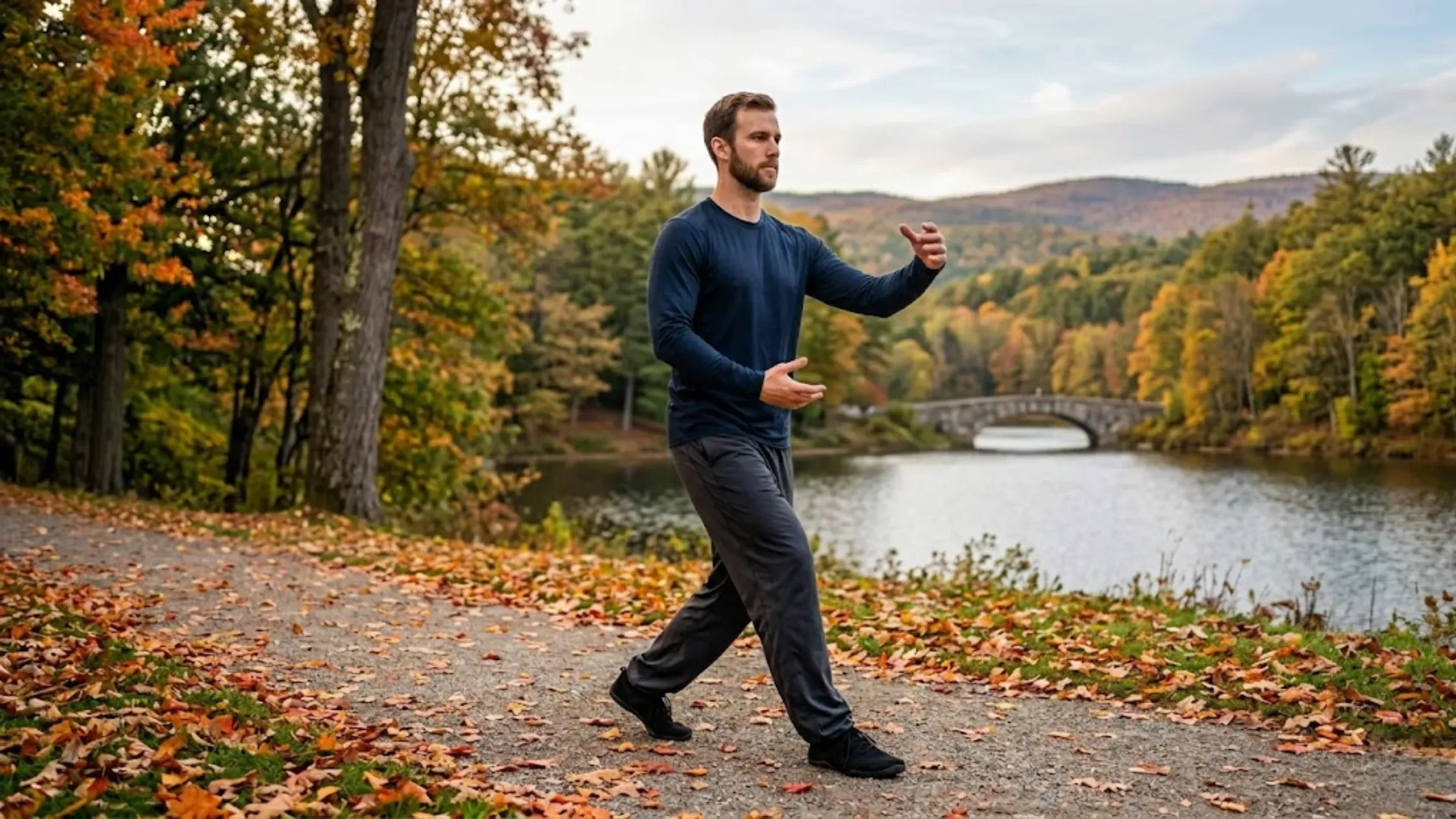
One of the most accessible aspects of Tai Chi walking is that it requires no prior experience, special equipment, or high fitness level. If you can stand and take a step, you can begin today.
Follow these steps to learn the fundamentals:
Step 1: Establish Your Starting Posture
Stand with your feet shoulder-width apart. Lift the crown of your head gently upward as if suspended by a thread. Relax your shoulders downward. Soften your knees slightly — do not lock them. Let your arms hang naturally at your sides. Take two or three slow, deep breaths before moving.
Step 2: Shift Your Weight Fully
Transfer your entire body weight onto your left foot. Your right foot should feel "empty" — it carries no weight. This full weight shift is the most important skill in Tai Chi walking. Practice this alone before adding any steps.
Step 3: Step Forward Heel First
With your weight on the left foot, slowly place your right foot forward, touching the ground heel first. Keep your toes raised. Do not shift weight onto the right foot yet.
Step 4: Transfer Weight Gradually
Slowly roll your right foot flat onto the floor — heel, arch, then toe — as you shift your body weight forward onto the right leg. Keep your torso upright throughout. Avoid leaning forward from the waist.
Step 5: Follow Through and Repeat
Once your weight is fully on the right foot, the left foot becomes empty. Draw it forward slowly and repeat the process. Maintain a relaxed, continuous rhythm.
- Take shorter steps than you naturally would
- Keep the knee of your front leg aligned over — not beyond — your toes
- Breathe slowly and steadily throughout
- Move your arms gently and naturally at your sides or in a soft rounded position at chest height
Begin with 5 minutes of practice daily and gradually extend to 10–15 minutes as the movement becomes more fluid and natural.
Indoor Tai Chi Walking
One of the practical strengths of Tai Chi walking is that it requires very little space. Unlike outdoor walking or most gym-based exercise, Tai Chi walking can be practiced effectively in a living room, hallway, or any small cleared area.
To practice indoors:
- Space requirement: A clear area of approximately 2 to 3 meters in length is sufficient to take several controlled steps, pause, and return.
- Surface: A flat, non-slip floor is ideal. Bare feet, socks with grip, or flat-soled shoes all work well.
- Adaptation for small spaces: If space is very limited, practice the weight-shifting and stepping movements in place — stepping forward with one foot and returning it, alternating sides.
- No equipment needed: Indoor Tai Chi walking needs no mats, weights, or tools. Your attention and a clear floor are sufficient.
Indoor practice is particularly valuable during poor weather, for those with limited mobility outside the home, and for building a consistent daily habit without reliance on external conditions.
FAQ
When practiced with correct technique — controlled weight transfer, appropriate step length, and knee aligned over the toes — Tai Chi walking is generally safe and may help reduce knee discomfort over time. If pain increases during practice, shorten your step and reduce the depth of your knee bend. Consult a healthcare provider if you have a diagnosed knee condition.
5 to 10 minutes is a productive starting point for beginners. Many practitioners build toward 15 to 20 minutes per session. Consistency matters more than duration — daily short sessions produce better results than infrequent long ones.
Yes. Tai Chi walking is specifically designed as an entry point into Tai Chi practice. No prior experience is required.
Research on Tai Chi broadly supports its role in reducing perceived stress and anxiety. The meditative quality of slow, rhythmic movement, combined with focused breathing, activates the parasympathetic nervous system — the body's rest-and-recovery state.
Start Practicing Today
Tai Chi walking is one of the most effective and accessible ways to begin building balance, body awareness, and lasting physical health — regardless of your age or fitness background. It requires no equipment, no large space, and no prior experience.