Tai Chi for Beginners: How to Start, What to Learn, and What to Expect
Published on May 9, 2026 | Updated on May 29, 2026
Table of Contents
- What Is Tai Chi?
- Why Tai Chi Is Ideal for Beginners
- Basic Tai Chi Movements for Beginners
- Tai Chi for Beginners at Home
- Tai Chi Walking for Beginners
- Beginner Tai Chi for Seniors
- What to Expect in Your First 4 Weeks
- FAQ
- Start Your Practice Today
What Is Tai Chi?
The most widely practised form today is Yang-style Tai Chi, codified in the 19th century by Yang Luchan and later standardised for modern teaching by his descendants. Its characteristic large, flowing movements performed at a consistent moderate pace make it the most accessible entry point for beginners and the style most commonly recommended by health practitioners for older adults.
In 1956, the Chinese government created the simplified 24-movement Yang-style form specifically to make Tai Chi easier to learn and more widely accessible. This 24-form sequence remains the global standard introduction to Tai Chi and is the most common starting point for new practitioners worldwide.
Why Tai Chi Is Ideal for Beginners
Tai Chi has unusually low barriers to entry compared to most forms of exercise, making it a realistic starting point for people across a wide range of ages, fitness levels, and physical conditions.
Basic Tai Chi Movements for Beginners
Before learning full sequences or forms, beginners benefit most from mastering a small set of foundational movements. These appear repeatedly across all Tai Chi styles and underpin the more complex postures that follow.
1. Wu Ji Standing (Opening Posture)
Wu Ji is the starting position for all Tai Chi practice. Stand with feet shoulder-width apart, weight evenly distributed between both feet. The crown of the head lifts gently upward as if suspended by a thread. Shoulders relax downward and away from the ears. Knees soften — never locked. Arms hang naturally at the sides, slightly rounded. The breath is slow and diaphragmatic.
Practise holding this posture for one to three minutes. It builds postural awareness and the quality of relaxed alignment that all subsequent movements depend on.
2. Weight Shifting
From Wu Ji, slowly transfer your entire body weight onto the left foot until the right foot is completely "empty" — carrying no weight. Then transfer back to centre, and across to the right. Maintain an upright torso throughout; the shift comes from the hips and legs, not from leaning.
This is the single most important foundational skill in Tai Chi. Full, conscious weight transfer is what distinguishes Tai Chi movement from ordinary walking and is the basis of every step and turn in the practice.
3. Raising and Lowering the Arms (Commencing Form)
From Wu Ji, slowly raise both arms forward to shoulder height, palms facing down, as you inhale. Then slowly lower them back to your sides as you exhale, bending the knees slightly as the arms descend. The movement should feel as though the arms float upward and sink downward without muscular effort.
This is the opening movement of the 24-form and teaches the coordination of breath, arm movement, and lower body relaxation that runs through the entire practice.
4. Parting the Wild Horse's Mane
Shift your weight onto the left foot and hold an imaginary ball of energy in front of you — left hand on top, right hand below. Step forward with the right foot, heel first. As you shift your weight forward, the right arm extends outward at shoulder height while the left hand lowers to hip level. The movement is performed entirely without tension, with all parts of the body starting and ending their motion simultaneously.
This posture is one of the most repeated in the 24-form and introduces the full coordination of stepping, weight transfer, and arm movement that characterises Tai Chi.
Tai Chi for Beginners at Home
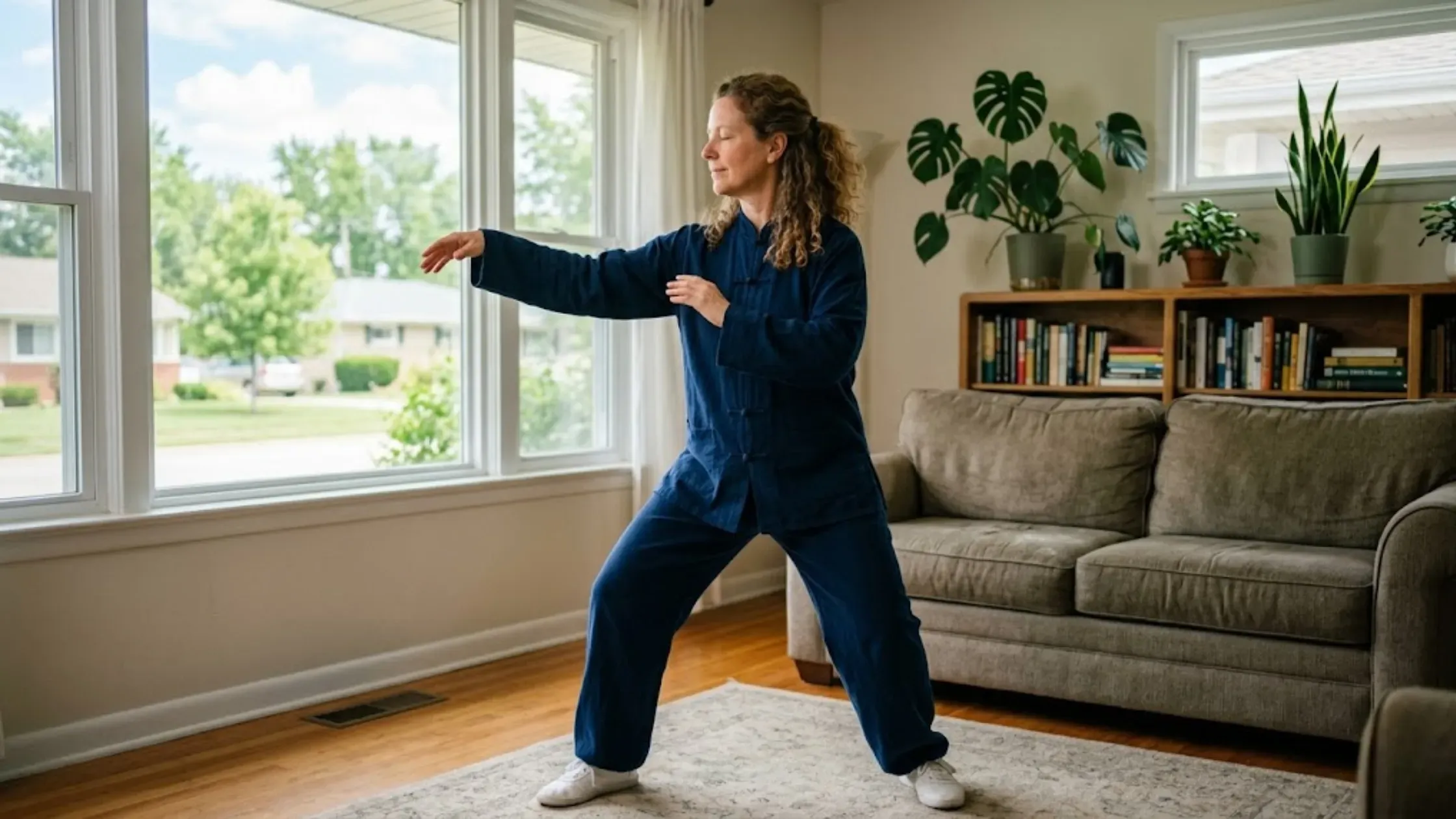
Practising Tai Chi at home is practical, effective, and requires very little preparation. The following guidelines help create the right conditions for productive home practice.
Tai Chi Walking for Beginners
Tai Chi walking is one of the most accessible entry points into the broader practice. It isolates the two most fundamental Tai Chi skills — full weight transfer and deliberate heel-to-toe stepping — and practises them in their simplest form, without the additional coordination demands of arm movements or full sequences.
For complete beginners, starting with Tai Chi walking before attempting full forms is a sound approach. It builds the postural and balance foundation that makes learning postures such as Parting the Wild Horse's Mane significantly easier.
The core technique involves four steps: standing fully on one leg before stepping, placing the moving foot heel-first onto the floor, rolling the foot flat as weight transfers gradually forward, and maintaining an upright spine throughout. Each step is slow, deliberate, and fully controlled.
Beginner Tai Chi for Seniors
Tai Chi is particularly well-suited to older adults beginning exercise for the first time or returning after a long break. Its low-impact nature, adaptability to physical limitations, and direct benefits for balance and joint health make it a clinically recognised option for healthy ageing.
Seniors new to Tai Chi should begin with shorter sessions — five to ten minutes — and focus initially on standing posture, breathing, and weight shifting before progressing to full movements. Practising near a wall or chair for support during the early weeks is entirely appropriate and does not indicate inadequate progress.
Yang-style Tai Chi is the most commonly recommended style for older beginners due to its upright stance and moderate pace. For those managing significant mobility limitations, chair-supported Tai Chi and Tai Chi walking offer effective alternatives that do not require standing balance.
What to Expect in Your First 4 Weeks
Progress in Tai Chi follows a consistent pattern for most beginners. Understanding what is normal in the early weeks helps maintain realistic expectations and supports commitment to practice.
Progress is gradual and cumulative in Tai Chi. Unlike fitness activities where performance improvements are rapidly measurable, Tai Chi develops subtler qualities — relaxation, postural efficiency, and body awareness — that compound over months of consistent practice.
Start Your Practice Today
Tai Chi asks very little to begin and returns a great deal over time. Five minutes of daily practice — done correctly and consistently — is enough to start building the balance, body awareness, and calm that make the practice worth continuing.
FAQ
The foundational movements of the 24-form Yang-style can be learned in several weeks of consistent practice. Developing fluency — performing the sequence smoothly with coordinated breathing and correct alignment — typically takes three to six months. Tai Chi is a long-term practice: most practitioners continue refining their technique for years.
A qualified teacher provides the most direct feedback on posture and alignment, which is difficult to self-assess. However, structured video instruction from certified instructors — as offered in the ZenFit app — is a practical and effective alternative for beginners who cannot access in-person classes.
Tai Chi is a low-to-moderate intensity exercise. It builds muscular endurance, improves balance and flexibility, and supports cardiovascular health, but it does not replicate the intensity of aerobic or resistance training. It is best understood as a complement to — rather than a replacement for — more vigorous exercise in people who are able to perform it.
Many people with knee pain practise Tai Chi safely. The key is keeping the front knee aligned over — not beyond — the toes during weight transfer, and avoiding stances that are lower than comfortable. If you have a diagnosed knee condition, consult your healthcare provider before beginning.
Yang-style Tai Chi, and specifically the simplified 24-form, is the most widely recommended starting point. Its upright posture, consistent moderate pace, and large, clearly defined movements make it easier to learn than more compact styles such as Wu or the more physically demanding Chen style.